What is a gas fee on Ethereum?
TL;DR: Just like you pay a wire or ACH fee when transferring money out of your bank account, you must pay a fee (called a network fee or gas fee) to send transactions or execute a smart contract on Ethereum. It is like paying a toll to use the Ethereum network.
What is gas?
You may think of filling up your car, or even what you ate earlier, when you hear the term gas. Yet the term has a special context in the world of crypto. Gas in crypto refers to the computational effort required to execute operations.
You must pay a gas fee in order to make a transaction or execute a smart contract on Ethereum. Regardless of the wallet you use, you will always need to pay for gas when executing transactions.
Need to send your mom some ETH? That transaction requires gas. Want to lend out your money via Compound? That transaction requires gas too. What about buying an NFT? You guessed it–gas. Gas is like a toll. If you want to use the highway, you have to pay the toll. The more duress a vehicle puts the road under, the higher the toll the driver must pay. Tolls are a lot higher for 18 wheelers than motorcycle drivers.
Similarly, the more complex the transaction on Ethereum, the higher the gas fee.
What is a gas limit?
Gas fees are denoted in Gwei, which is just .000000001 ETH. You can think of Gwei like cents, since 1 cent is .01 of a dollar. For every transaction you want to make, you must set what fee you are willing to pay for your transaction to be executed.
The maximum amount of gas you are willing to pay for in a particular transaction is called the gas limit. Additionally, you must input the gas price for each transaction as well. The gas limit x gas price = gas fee. You pay the gas fee when you submit a transaction.
Lucky for you, MetaMask calculates the approximate gas fee you should set for you based on how fast you want your transaction to be confirmed.
Where your gas fees go
You might be wondering “why will my transaction be confirmed if I set a higher gas fee?” An excellent question!
When you submit a transaction on Ethereum, you are competing with others who also want to submit a transaction. While you might be sending your mom some Ether, someone in India might be trading on Uniswap. Each person is trying to have their transaction executed at the same time. But, only so many transactions can be included in an Ethereum block, and there are only new blocks every roughly 13 seconds. In fact, each block contains only 12.5 million units of gas. This means everyone is competing against one another to have their transaction included in the next block. When demand is high, and supply is constrained since only so many transactions can be included in a block, price must increase.
But when you submit transactions, where do they before miners approve them? These transactions go to the mempool, short for “memory pool.” The mempool is where all the transactions that have been submitted — but not yet verified — live. In short, the mempool is the waiting queue for validation. Miners, who validate transactions before execution to make sure they aren’t malicious, pick the transactions that should be included in the next block from the mempool.
“So why would miners pick my transaction from the mempool before everyone else?” Because I will pay them more of course!
Miners select what transactions should be included in the next block based on how high the gas fee users set prior to submitting the transaction. The higher the gas fee, the higher chance a miner will be willing to include your transaction in the next block. This situation is where the competition comes in, since you compete with everyone else setting gas fees during that time frame for block space.
Why do transactions take so long?
Since all users compete against one another for block space, when you set your gas fee too low, miners will opt not to include your transaction in a block in the near future. Thus, your transaction takes so long because you did not set the gas fee high enough for your transaction to be included in a near future block. You will have to wait for the gas fees that other users are willing to pay to go down for your gas fee to be attractive to miners.
Series Disclaimer: This series article is intended for general guidance and information purposes only for beginners participating in cryptocurrencies and DeFi. The contents of this article are not to be construed as legal, business, investment, or tax advice. You should consult with your advisors for all legal, business, investment, and tax implications and advice. Consensys is not responsible for any lost funds. Please use your best judgment and practice due diligence before interacting with smart contracts.
MetaMask Gas Fees: How Much Is A MetaMask Gas Fee?

Paying gas fee charges has recently become an expensive affair, but are MetaMask gas fees as high as one assumes in general?
Whether it’s OpenSea gas fees or Axie Infinity gas fees, users have particularly been worried about notoriously high gas charges that the network usually levies for processing a normal crypto transaction.
Table of contents
How Much Are MetaMask Gas Fees?
MetaMask Gas Fee Too High
How To Avoid High Gas Fee Charges
While maneuvering the extensive metamask fee structure alongside decoding the new metamask errors, Let’s take a look at what MetaMask gas fee charges are all about.
How Much Are MetaMask Gas Fees?
The MetaMask gas fees refer to the transaction fee on the Ethereum blockchain, and so tend to reflect the existing gas fees on ETH.
As such, there is no flat fee on MetaMask. Its gas fees depend on the state of Ethereum. While some users hope the Ethereum gas fees after the merge could drop, it might not be until after the full Ethereum 2.0 release of sharding that we see improvements here.
On its website, MetaMask notes that a normal transaction conducted via the platform generally charges 21,000 Gwei, although this does vary.
- Read More:Ethereum 2.0 Transactions Per Second: Ethereum Will Reach 100,000 TPS After Upgrade, Says Vitalik Buterin
MetaMask Gas Fee Too High
If your MetaMask gas fees are too high, there are a few aspects you can tweak to try and reduce them.
According to MetaMask, the price of gas fees are usually dynamic and varies depending on factors including network congestion and traffic.
Congested networks and high demand render the network to levy high gas fee charges and make the transaction too expensive. Popular new NFT releases, for example, on Ethereum are also one of the main reasons that contribute to the high gas fee charges of MetaMask.
How To Avoid High Gas Fee Charges
To avoid high gas fees, there are several recommendations followed by crypto trades.
The first is to try changing your gas fee settings in MetaMask. However, you should note that tweaking the gas settings can slow down your MetaMask transactions.
Alongside this, you should attempt to understand the peak timings and avoid conducting your MetaMask transfers at those times.
And finally, you can try cheap network alternatives to avoid paying high gas fee charges. You can add Polygon to MetaMask or add Avalanche to MetaMask, for example.
For more articles like this, take a look at our Planet Crypto page.
Any content provided on this website is for general information purposes only and does not constitute legal or financial advice. Cryptocurrency is a volatile market and trading is a high-risk activity that does not guarantee returns. (learn more) Gfinity Esports is supported by its audience. When you purchase through links on our site, we may earn an affiliate commission. Learn more. Looking for specific products? Visit Stockinformer.co.uk / stockinformer.com.
Что такое gas fee metamask
What has changed:
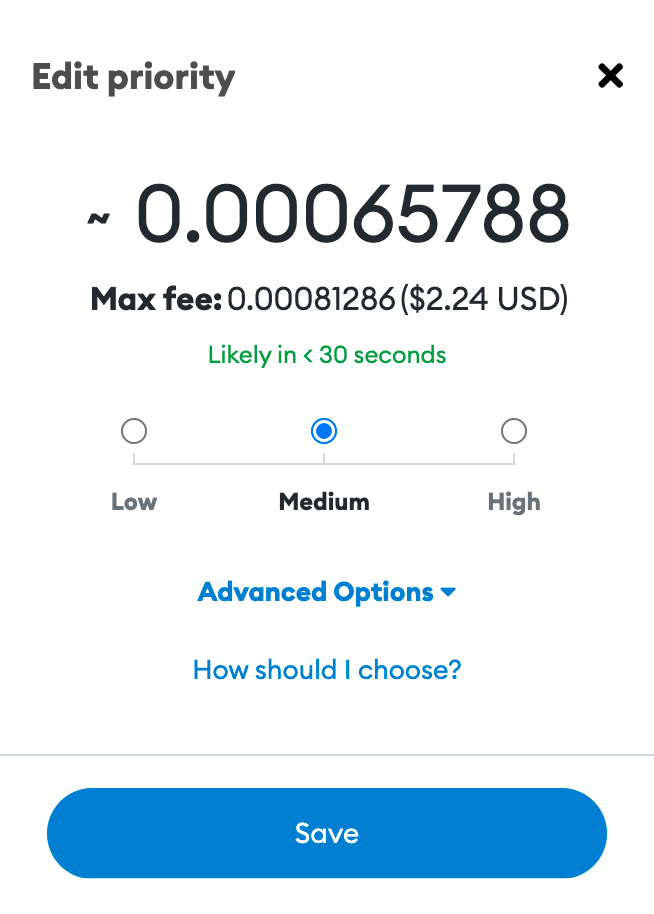
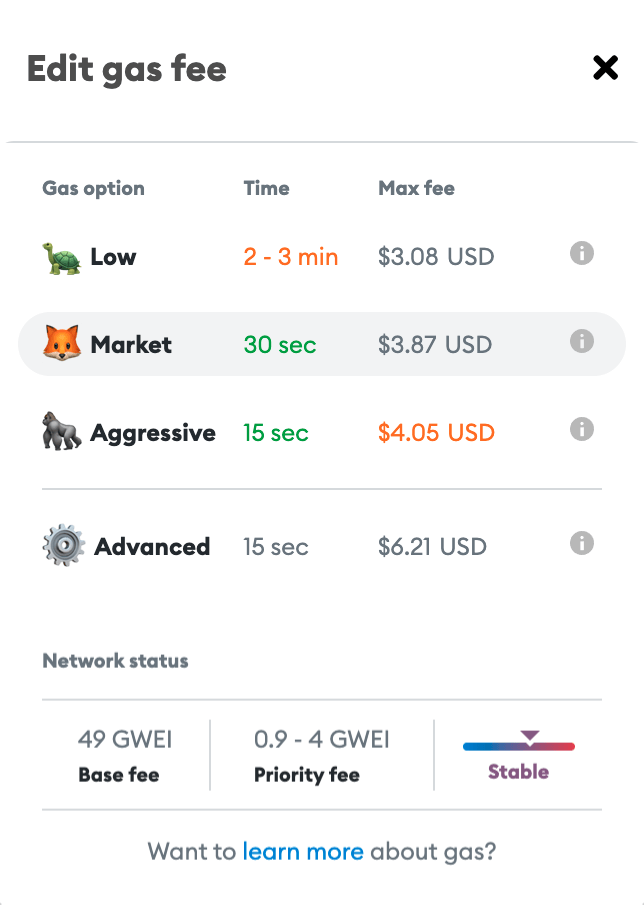
After EIP-1559 launched, we’ve been observing the market and adapting our estimations and UI to account for the dramatic price spikes that still exist on the Ethereum Mainnet due to popular NFT drops and other projects. When editing estimations, we have changed terms from low, medium, high to low ��, market �� and aggressive �� respectively:
- “Low“ (previously “Low”): is much lower than market prices and it allows a user to pay a lower fee when they are willing to wait a longer time. It allows you to wait a longer period and skip the price spikes (i.e. save money). Note that this setting is based on past trends, which means we can never be sure the transaction goes through. If you require a transaction to go through, this may not be the right setting for you.
- “Market“ (previously “Medium”): reflects market prices.
- “Aggressive“ (previously “High”): is much higher compared to market prices. It allows you to set a really high max fee and priority fee to increase the likelihood of your transaction being successful if you’re expecting to participate in a gas war.
NOTE: As of the rollout of the EIP-1559 updates on Extension, you will have to opt-in to this new experience. You will see a prompt to opt in, but you can also find it under “Settings > Experimental” where you can toggle the button ON:
In the near future we will change this to automatic opt-in.
Why we changed it:
We changed this to be more accurate. Before, «Low», «Medium» and «High» were all variations of «market” prices in a way. Now, there is a bigger difference between the various options, «Market» is the current market price. Low means a «Lower than market» which is not always «slow». «Aggressive” is not just high, but really high compared to market rate.
Gas estimate changes
Changes in Advanced Settings
In our Advanced Settings, we made two changes:
1. MAX BASE FEE AND PRIORITY FEE SIMPLIFICATION
What has changed:
We simplified how to customize the Max Base Fee and the Priority Fee. No more math required to calculate the Max Fee. Hooray!
Why we changed it:
For a few reasons:
- The first iteration of our EIP-1559 Advanced Settings UI turned out to be a bit too technical and not necessarily relevant for users. The new experience includes more information so it’s easier to make decisions for your priority fee and max base fee.
- We know some users spend time checking gas prices with other services. Now, you no longer need to do this: we added some details below the “Max base fee” and “Priority fee” inputs that help you understand the latest gas status. Below you can find what we added and what it means:
- Current: Most recent gas fees from the network
- Arrow: Trend (up or down from last block)
- 12hrs: The 12 hour range
2. SETTING YOUR ADVANCED SETTINGS AS YOUR DEFAULT SETTINGS
What has changed:
You can now set “Advanced” as your default option and it remembers your last set values to better support users who want to use their custom gas strategy.
Why we changed it:
This change will help people pursuing extreme use cases such as NFT drops, yet still optimizing for the everyday transaction by providing network status, clear inclusion time estimates and max gas fees. For users that are mostly using MetaMask for aggressive asset buying, you can go directly to the advanced gas option each time saving you several clicks.
Advanced Settings changes


The Use of Icons/Emojis to Reflect Gas Estimations (Low, Market, Aggressive)
You will be in good company when setting your Gas Estimations:
- Low ��
- Market ��
- Aggressive ��
General FAQs
What is EIP-1559?
EIP-1559 has changed Ethereum’s market mechanisms to pay for transaction fees. EIP-1559 got rid of the first-price auction and replaced it with a fixed-price sale. The significance of this change is that people submitting transactions won’t have to guess as much about how much gas is required, as there is a ‘base fee’ to be included in the next block. For users or applications that want to prioritize their transaction, they can add a “tip” (priority fee) to pay a miner. You can read about EIP-1559 and its changes to Ethereum in more detail here.
Will EIP-1559 make ETH deflationary?
EIP-1559 burns the ETH spent as base fee of the transaction fee. That ETH is removed from the supply. Under EIP-1559, ETH becomes more scarce, as all transactions on Ethereum burn some amount of ETH.
Modeling exactly how deflationary EIP-1559 is difficult since you have to project variables like expected transactions, and, even harder to predict, expected network congestion. In theory, the more transactions that occur, the more deflationary pressure that the burning of the base fee will have on the overall Ethereum supply. The ETH supply may deflate more or inflate more at different times based upon the number of transactions that happen on the network. Since the update to EIP-1559 in August 2021, we have seen deflationary days on the Ethereum blockchain.
After the merge to Proof of Stake, Justin Drake’s model estimates as a “best guess” that 1,000 ETH will be issued per day, and 6,000 ETH would be burned. Assuming more validators join and the staking APR is 6.7%, the annual supply change will be -1.6million ETH, reducing the annual supply rate by 1.4%.
Despite growing awareness of MEV and potential EIPs to bring more transparency, we can expect arbitrage opportunities to only get more sophisticated as institutional financial traders use DeFi protocols. This could mean that there may end up being way more spent on tips per block than the base fee. Zhu Su and Hasu actually predict that less than half of today’s fees could be burned by EIP 1559.
How much ETH has been burned?
You can track that here.
What has changes for me as a user with EIP-1559?
The idea of EIP-1559 is to make gas fees more or less transparent for the user. Therefore, wallets will be able to have better estimates and make transaction fees more predictable. They won’t have to rely much on external oracles since the base fee is managed by the protocol itself. There will be additional user experience benefits like automating the fee bidding mechanism, thus reducing delays in transaction confirmation.
What is the difference in gas fees on L1 vs L2?
To understand why gas cost is different on Layer 1 compared to Layer 2 on Ethereum, we need to understand the difference between Layer 1 and Layer 2 first.
Layer 1 is the original Ethereum blockchain which, at the time of writing, is a proof of work (POW) blockchain. Layer 1 has a limited number of transactions per second it can process. When it’s busy on the chain, in other words, a lot of people are making transactions at the same time, the cost of these transactions go up. This can lead to transaction costs of sometimes over hundreds of dollars. This simply isn’t worthwhile unless you’re a whale, or just plain desperate to make that transaction. Ethereum 2.0 aims to solve this problem with Proof of Stake, which allows for faster transactions amongst other things. While we wait for Ethereum to move to Ethereum 2.0 (planned for 2022), there are solutions that solve the problem of high transaction costs: Layer 2.
Layer 2 is defined as “a collective term for solutions designed to help scale your application by handling transactions off the Ethereum Mainnet (layer 1) while taking advantage of the robust decentralized security model of Mainnet”. They are networks that are built “on top” of the Ethereum blockchain that can handle transaction fees off of the original Ethereum blockchain. This alleviates the number of transactions per second made on the original Ethereum chain, or Layer 1, which allows to scale and therefore decrease the transaction, or gas costs.
We believe Layer 1 will continue to act as a valuable base issuance and settlement layer for protocol assets. Whereas, on Layer 2, developers and end-users will want to take advantage of the off-chain transactions and computations to keep the base layer free of congestion. That means, because of Layer 2’s unique optimizations and scaling solutions, transaction processing speeds will be faster while reducing gas fees will be lower than Layer 1.
Fees
Will EIP-1559 make gas fees cheaper?
No, this is not the intent of the EIP. As a side effect of a more predictable base fee, EIP-1559 may lead to some reduction in gas prices if we assume that fee predictability means users will overpay for gas less frequently. With EIP-1559, the base fee will increase and decrease by 12.5% after blocks are more than 50% full. For example, if a block is 100% full the base fee increases by 12.5%; if it is 50% full the base fee will be the same; if it is 0% full the base fee would decrease by 12.5%.
The ongoing movement of applications to rollups and Layer 2s will greatly reduce gas fees.
How do I set the right gas fee?
MetaMask will provide you with three options when setting the gas fee:
- “Low“ (previously “Low”): is much lower than market prices and it allows a user to pay a lower fee when they are willing to wait a longer time, for example when withdrawing funds or other non-time sensitive transactions. It allows you to wait a longer period and skip the price spikes (i.e. save money). This setting is based on past trends, which means we are less sure the transaction goes through. If you require a transaction to go through within a specific time frame, this may not be the right setting for you.
- “Market“ (previously “Medium”): reflects market prices.
- “Aggressive“ (previously “High”): is much higher compared to market prices. It allows you to set a really high max fee and priority fee to increase the likelihood of your transaction being successful if you’re expecting to participate in a gas war.
Should I edit the gas fee?
You will be able to choose between a low, market or aggressive gas fee. See the question above for what these mean. Additionally, you can edit your gas limit, priority fee and max fee in the “Advanced Settings”. This will override the default settings of low, market or aggressive that were applied by MetaMask or the application you are interacting with.
How much faster will my transaction go through on EIP-1559?
This remains unknown for now.
How is the gas fee calculated?
Gas fees are determined by how full the block is. EIP-1559 establishes the market rate for transaction inclusion and allows Ethereum to have double the blockspace (by increasing max gas limit per block from 12.5M to 25M). It then targets blocks to only be 50% full.
When the network is >50% utilization, the base fee is increased
When the network is
Over time, Ethereum’s block size will average out to be the same exact size, but this extra capacity allows for flexibility with transaction inclusion. In essence, it will eliminate the extra step in setting the gas price to make a transaction.
Are gas fees higher on MetaMask than anywhere else?
For the «Market» setting, we do our best to find the right balance between cost and confidence/speed. Gas costs are an estimate and what you actually pay should be similar across wallets. Using the “market” setting is what we’d expect to be similar when comparing to other wallets.
«Low» and «Aggressive» will vary much more compared to other wallets based on how these settings work.
How much will the estimated gas fee differ from what I will actually pay?
The estimated gas fee is a range. The upper bound of this range is the maximum the user will be paying for a transaction. We are analyzing data to get a better understanding of the difference between the estimated gas fee and the actual gas fee.
Should I consider a different approach for setting gas fees for Swaps vs other transactions?
MetaMask will have three options to set a gas fee: low, market and aggressive (more details in FAQ above “How do I set the right gas fee?”) and will preselect the fee we think is relevant to your transaction type. You can change this if you prefer, but we provide the best recommendation. For time-sensitive transactions such as Swaps, we recommend and will pre-select an “aggressive” gas fee.
What does base fee/max fee/priority fee/etc. mean?
Refer to our Glossary for detailed definitions about (new) terms.
Since I am setting a “max priority fee,” how can I see the amount that I actually pay for a transaction?
You can view the transaction activity for the estimated gas fee paid, or view the “effectiveGasPrice” in the transaction receipt on block explorers like Etherscan.
Can I transact without a priority fee (“miner’s tip”)?
Yes you can, but there is the possibility that other transactions (that do include a priority fee) will be prioritized as miners are incentivized to include transactions with a priority fee.
Will typical users be selecting the “tip” amount or will that be part of an overall fee preselected for users?
The “tip”, or priority fee, will be included as the overall “gas fee” that users see to submit a transaction. You will also be able to “edit gas fee” to increase or decrease this “tip”.
Where can someone see what they paid for a tip/priority fee? Will block explorers like Etherscan now show this information?
Most of the tooling will be updated accordingly to show the new information related to the EIP. There will now be an “effectiveGasPrice” in the transaction receipt, which returns the price paid post-execution by the transaction (i.e. base fee + priority fee).
Integrations
How does EIP-1559 work with supported hardware wallets on MetaMask?
Yes, all hardware wallets that are currently supported by MetaMask, Ledger Trezor, Lattice1, Keystone and Airgap are all supported.
Is the implementation on a wallet or dapp level? In other words, will all my dapp connections show the new interface in the wallet, or only the dapps who have adopted EIP-1559?
If the dapps haven’t switched over to the new EIP-1559 fields, MetaMask will detect this and use gasPrice as maxFeePerGas. This means the user will potentially overpay for their transaction. As of December 2021, EIP-1559 is used by about 50% penetration.
User experience
How else might EIP-1559 change wallet user experience?
This will differ per wallet. The idea is to make gas fees based on block demand more transparent for the user. Wallets like MetaMask will be able to have better estimates, and won’t have to rely much on external oracles since the base fee is managed by the protocol itself. Additionally, when using MetaMask, you can decide between low, market or aggressive gas fees. Although the recommended type will be pre-selected, the user can change this before confirming the transaction. Additionally, users can change the max fee, max priority fee, and Gwei in the “Advanced” settings. Doing this will override the initial low, market, or aggressive settings.
Is the user experience going to be different during times of network congestion?
During periods of high network congestion, the base fee will adjust by 12.5% depending how much demand surpasses the ideal gas limit per block until that demand abates. Instead of a first-price auction, users will have a better sense of how congested the network is by how high the base fee is. If it is too congested, the user can either pay that price or not. Or, they submit a lower fee and wait for the price to go down in the future.
FAQs for developers
What changes for me as a developer with EIP-1559?
We recommend both dapp developers and networks to switch to EIP-1559 fields and block headers respectively if they haven’t already. If not, the legacy gasPrice will be used as maxFeePerGas, which means that the user will potentially overpay for their transaction.
How do I implement EIP-1559 with MetaMask for my dapp?
You can read through the EIP-1559 specifications and also look through the EIP-1559 sections from Ethereum’s JSON-RPC specs.
Is the implementation on a user or dapp level? In other words, if I implement EIP-1559, will all my dapp users see the new gas fee settings, or only the users who have agreed to adopt EIP-1559?
It’s both. The user interfaces with the Ethereum network through a client (wallet). Users can also interface with the network through a dapp. In the case that the dapp hasn’t switched over to the new EIP-1559 fields, MetaMask will detect this and show pre-1559 gas estimation UIs.
Who estimates gas estimates, the dapp or MetaMask?
Gas estimates are done by MetaMask.
Are there any potential risks for dapps on Ethereum?
All change is risky, but the Ethereum community has a track record of strong software development and coordination. There are some potential risks EIP-1559 presents to network actors that are sensitive to timing, such as oracles. Oracles usually provide the pricing information needed to support various actors in the DeFi ecosystem. For example, Compound needs to know the valuation (i.e. price x number of assets) of a user’s collateral in order to determine if their position needs to be liquidated or not. The valuation of these assets have to be constantly updated, and Compound relies on oracles to update this information. More information about this can be found in this article.
What are the changes my project may need to consider if I haven’t switched over yet?
The technical changes for EIP-1559 (and EIP-3198) that may impact your project include a new block format, a new transaction format, the new values for selecting a gas price, a new JSON RPC call and changed behaviour for several JSON RPC calls. For details about these changes, refer to this Infura blog post.
Glossary
EIP-1559 (Ethereum Improvement Protocol 1559):
This proposal was initially created by Vitalik Buterin with the intent of reducing the cost per transaction by not paying the miners the gas fee that Ethereum users pay by bidding for the gas fee. Ethereum users will now have a more fairly accurate estimate of the average gas price of a transaction based on the network’s internal averages. A side effect of a more predictable base fee may lead to some reduction in gas prices if we assume that fee predictability means users will overpay for gas less frequently. For more information about how EIP-1559 will change Ethereum, see here.
Gas fee:
Gas refers to the transaction fee on the Ethereum blockchain. It is what users pay to get their transaction validated, or completed.
- “Low” ��: is much lower than market prices and it allows a user to pay a lower fee when they are willing to wait a longer time. It allows you to wait a longer period and skip the price spikes (i.e. save money). This setting is based on past trends, which means we can never be sure the transaction goes through. If you require a transaction to go through, this may not be the right setting for you.
- “Market” ��: reflects market prices.
- “Aggressive” ��: is much higher compared to market prices. It allows you to set a really high max fee and priority fee to increase the likelihood of your transaction being successful if you’re expecting to participate in a gas war.
Base fee:
Generated by the protocol. Represents the minimum gasUsed multiplier required for a transaction to be included in a block (i.e. for a transaction to be completed). This is the part of the transaction fee that is burnt.
Max Priority fee — i.e. Priority fee or the miner’s tip
MetaMask will initially set this amount based on the previous block’s history. However, users will be allowed to to edit this amount within the Advanced Settings. It is added to the transaction and represents the part of the transaction fee that goes to the miner.
Max fee:
MetaMask will initially set this amount based on the previous block’s history. However, users will be allowed to edit this amount within the Advanced Settings. It represents the maximum amount that a user is willing to pay for their transaction (inclusive of base fee and max priority fee). The difference between max fee per gas and base fee + max priority fee is “refunded” to the user.
Gas limit:
The maximum amount of gas units that the transaction may be able to consume.
Gwei:
​​Gwei is a unit of ether, the smallest denomination, which stands for gigawei (or 1,000,000,000).¹ Gwei is used for gas fees, or rather payments made by users to compensate for the computing energy required to process and validate transactions on the Ethereum blockchain.²
Slippage:
Slippage is the expected percentage difference between a quoted and an executed price.
How does metamask come up its suggested gas fees?
How does metamask come up its suggested gas fees? How does it come up with a certain amount? What is it optimised for? Should you just use it or should you set your own?
asked Sep 24, 2021 at 7:41
1,813 3 3 gold badges 19 19 silver badges 45 45 bronze badges
2 Answers 2
It uses web3.eth.estimateGas (https://web3js.readthedocs.io/en/v1.2.11/web3-eth.html), which basically runs the transaction locally and returns the amount of gas used. It’s pretty good most of the times but it can definitely get it wrong. Not sure in which specific cases though.
answered Sep 24, 2021 at 7:45
4,127 1 1 gold badge 6 6 silver badges 22 22 bronze badges
On the Ethereum network, the gas fee is composed of a base fee and a priority fee.
The base fee is retrieved from the network and is based on the network workload. MetaMask will call the eth_getBlockByNumber method, this gives a lot of information about the block, including the base fee. You can retrieve the base fee also by calling the eth_getGasPrice method.
Then the priority fee is what goes to the miner. Generally, 2 Gwei is considered the minimum needed for a miner to pick it up.
Then the acual ETH value used for gas is calculated by doing:
(base fee + priority fee) * gas limit
The gas limit in 21000 units for a regular transfer on the ETH network, but it can be retrieved from the network using the eth_estimateGas method.
I have a repo that shows all this in Python using web3.py if you want to see how it works!