How to manually import/export Intermediate Certificate in Adobe
How to manually import/export Intermediate Certificate in Adobe
Introduction
Starting February 27, 2023, GlobalSign will be migrating to a new root hierarchy for issuance of AATL Signing Certificates.
This change is part of our strategy which focuses on minimizing the impact due to Web Trust related changes/issues on Document Signing roots.
Any reissue or renewal of Certificates will automatically be delivered from the new R45 issuing CA named: GlobalSign GCC R45 AATL CA 2020 instead of the current one: GlobalSign GCC R6 AATL CA 2020. This will occur after the migration to the new CA is completed.
For Customers who may be impacted especially HSM Users, you need to manually import the new hierarchy into your applications.
Also, if the Adobe Approved Trust List is not automatically updated, you can use this method.
Step-by-Step Guidelines
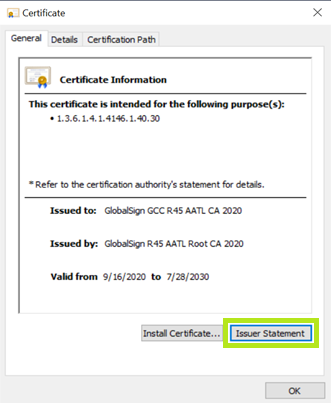
- Download a copy of GlobalSign GCC R45 AATL CA 2020 from this link:
https://support.globalsign.com/ca-certificates/intermediate-certificates/aatl-adobe-cds-intermediate-certificates - Save it as a .cer file to proceed.
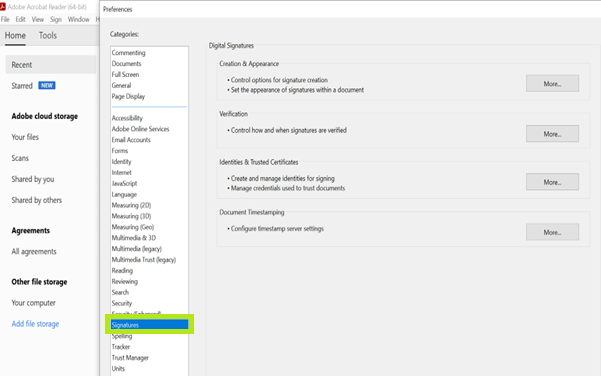
Open the Adobe Application, then click Edit >Preferences >Signatures as shown below.
In Identities & Trusted Certificates, hit More and go to Trusted Certificates.
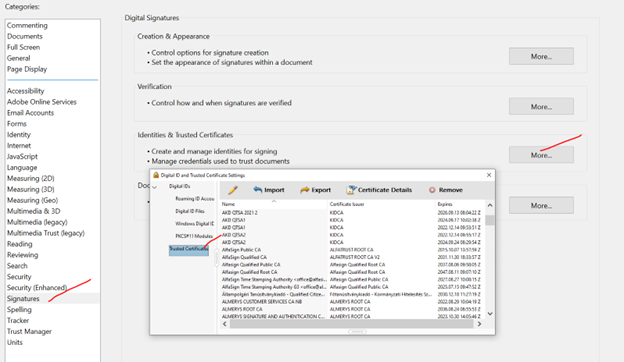
Once you click More, go to Trust Certificates >Import >Browse.
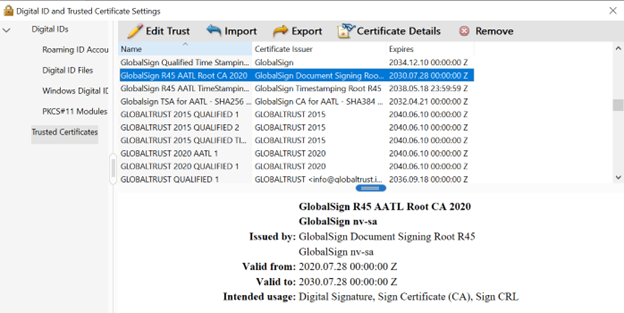
Look for the Intermediate Certificate (.cer file) and select it. Then, click Import to continue.
Now, you have successfully imported the Intermediate Certificate as shown below.
Related Articles
PersonalSign Intermediate Certificates
Dec 16, 2019, 3:25 PM
Intermediate Certificates help complete a «Chain of Trust» from your SSL or client certificate to GlobalSign’s root certificate. As a PersonalSign customer, intermediate certificates are already bundled in the .pfx (PKCS#12) you downloaded after completing your purchase. No action should be required. If you did a custom order where you provided a CSR, you may need to download a PersonalSign intermediate certificate listed below.
Code Signing (Standard & EV) Intermediate Certificates
Mar 9, 2020, 2:04 PM
Intermediate Certificates help complete a «Chain of Trust» from your SSL or client certificate to GlobalSign’s root certificate. The Standard Code Signing Certificates and EV Code Signing Certificates should automatically install the intermediate certificate on the USB token. If this does not happen you can use the links below to download the Standard Code Signing Intermediate or the EV Code Signing Intermediate.
Administration Intermediate Certificate
Mar 9, 2020, 2:32 PM
This support article contains the details of the Administration Intermediate Certificate. Intermediate Certificates help complete a «Chain of Trust» from your SSL or client certificate to GlobalSign’s root certificate.
Color
Method of Action is a collection of tools, games and articles to help you learn design.
Before you start
Calibrate your screen
Quick guide to get the best color accuracy
Color blind assist
Tap to
confirm match
Color
saturation
complementary
analogous
triadic
tetradic
Press to get started
will start in 3
saturation
complementary
Adjust your brightness and contrast
You should barely be able to see a difference between the inner and outer color. If you’re on a laptop also make sure to adjust the viewing angle of your screen. Don’t worry if you can’t see all the colors, the game has built-in tolerance and will give your a perfect score if the colors are very similar.
Start game with color blind assistance
Experimental color blind assistance
We implemented a solution for players with color perception deficiencies: each primary color represents a shape, and the intermediate steps are represented by a morph between each shape. The shape is meant as a general guide to pick the right hue, you will still need to adjust the color to get a good score. Let us know how it works out for you at hello@method.ac.
Requirements for certificates to sign PDFs in Adobe Reader?
I’m trying to set up PDF digital signatures using certificates generated by openssl. I have generated a CA certificate, and used that to sign end user certificates, which I archive in PKCS#12 format. I have imported and trusted the CA certificate in Adobe Reader, and it shows that the end-user certificates as being trusted to «sign documents or data». I have also set up a CRL server, and Adobe Reader successfully confirms that the end-user certificate has not been revoked. However, when I select edit>preferences>signatures>Digital ID and Trusted Certificate Settings, select the digital identity of the end user, and select «Usage Options» from the top banner, all the options including «Use for Signing» are greyed out. I have tried a variety of KeyUsage and ExtendedKeyUsage extensions on the end user certficate. For example,
keyUsage = critical, digitalSignature, nonRepudiation extendedKeyUsage = 1.3.6.1.4.1.311.10.3.12, 1.2.840.113583.1.1.5 # (Microsoft Document Signing and Adobe Authentic Documents) These appear to meet the requirements stated in https://www.adobe.com/devnet-docs/etk_deprecated/tools/DigSig/changes.html#everything-after-11-0-10 under version 11.0.09 for KU and EKU extensions. I have also tried with no extensions, as that documents indicates that should also be accepted. I have tried both importing the end-user certificate directly into Reader, and importing it into the Windows credentials store, which also makes it visible in Reader. However the «Use for signing» option remains stubbornly greyed out! The same certificates can be used to sign PDFs with SignServer, and Reader then shows that the document has been properly signed by a trusted certificate. Thanks in advance for your assistance.
- certificate
- certificate-authority
- self-signed-certificate
- digital-signatures
- adobe
Manual Configure Trust in Adobe Acrobat
This is a guide on how to manually configure trust of a test document signing certificate in Adobe Acrobat.
If you are using a test certificate to digitally sign a PDF file from Adobe Acrobat, the digital signature will not immediately appear as valid. The free test certificates generated by the SSL.com sandbox are intended for test purposes, do not undergo validation and are not automatically trusted. This is in contrast to using SSL.com production certificates which are issued after an identity validation process and are trusted by Adobe readers by default.
SSL.com’s Document Signing Certificates are trusted worldwide to digitally sign and certify Adobe PDF documents with secure digital signatures.
Requirements
There are 3 requirements for this guide:
a) A test document signing certificate: In this guide, we are using an SSL.com test document signing certificate that can be ordered using SSL.com’s sandbox/test environment. For a detailed guide on how you can create an SSL.com sandbox account, please refer to the article: Using the SSL.com Sandbox for Testing and Integration .
b) A document signing application: In this case, we will be using SSL.com’s eSigner remote signing service which securely stores digital certificates in the cloud. Specifically, we will be using eSigner Express, SSL.com’s GUI web application that lets users create digital signatures on most internet browsers, with no need for hardware tokens to store the digital certificate.
c) A PDF file opener: In this guide, we are using Adobe Acrobat.
Steps
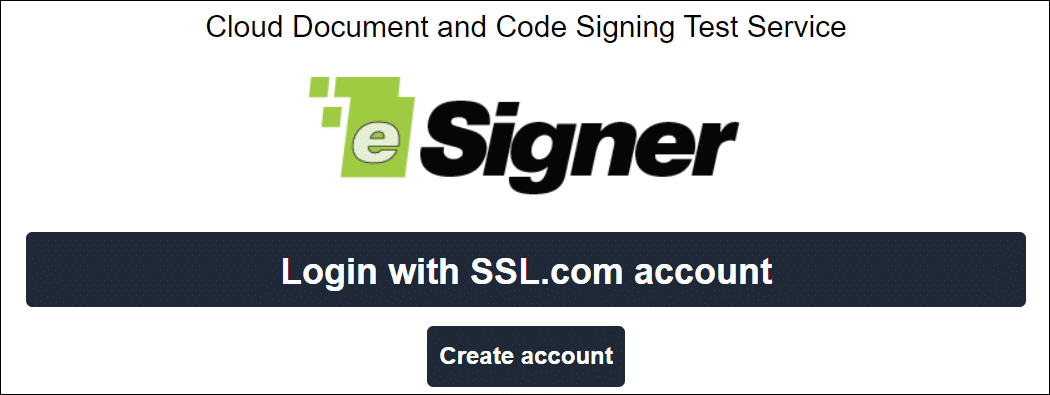
1. Login to the eSigner sandbox environment at https://try.esigner.com/ . If you do not yet have an account, select the Create account option.
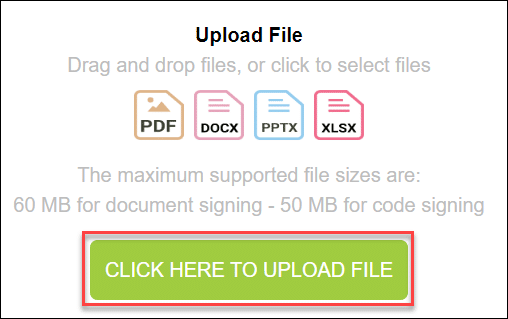
 2. Click the green button CLICK HERE TO UPLOAD FILE to load your PDF document to eSigner Express. You can upload a maximum file size of 60 megabytes for document signing.
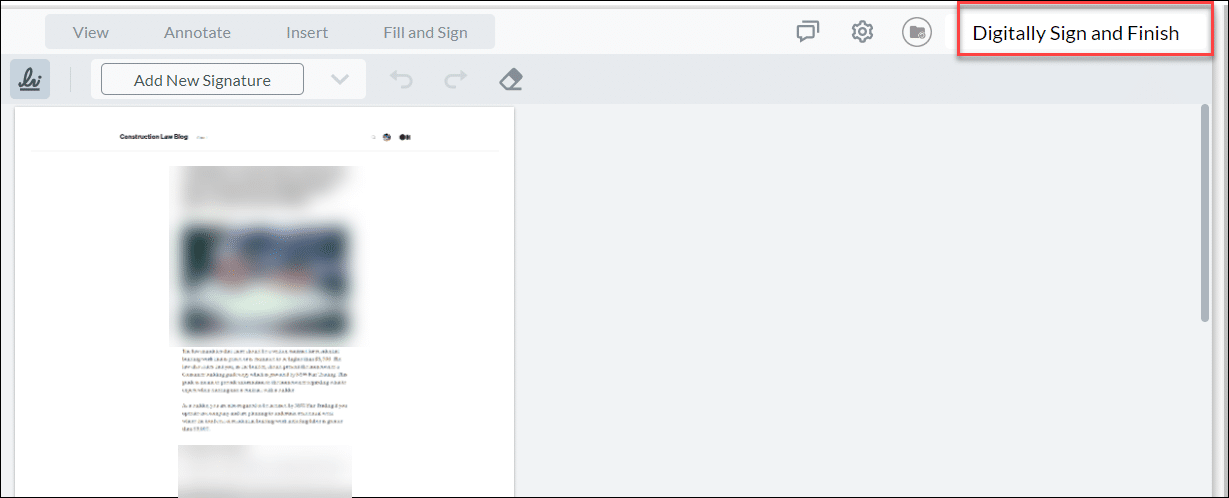
 3. Select your file and click the Open button to upload it to eSigner. Once uploaded and ready to sign, click the Digitally Sign and Finish tab.
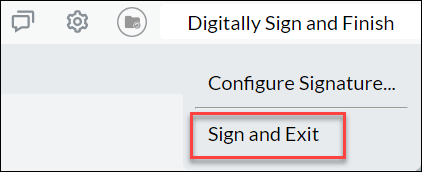
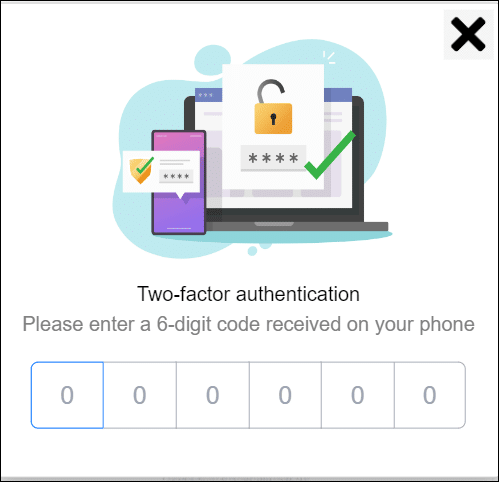
 4. Click Sign and Exit . You will then be prompted for the 6-digit verification code sent either to an Authenticator app on your phone or directly to your phone’s SMS inbox, depending on the option you selected when you enrolled your document signing certificate to eSigner.
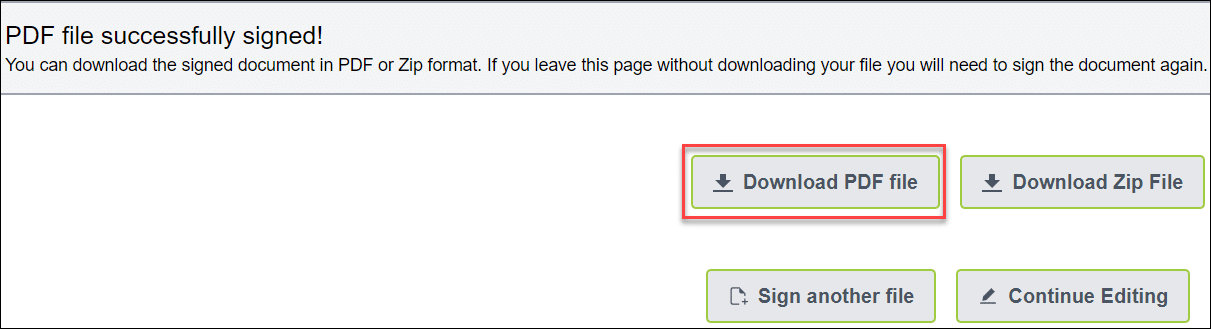
 5. A message will appear showing that eSigner Express has successfully signed your PDF document. Click the Download PDF file button to view the digital signature on the file.
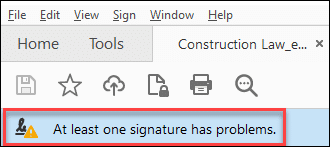
 6. Upon opening the digitally-signed PDF file, Adobe will show the message “ At least one signature has problems ” to indicate that the test certificate is not trusted yet. There will also be an exclamation point symbol to further indicate that it is not trusted.
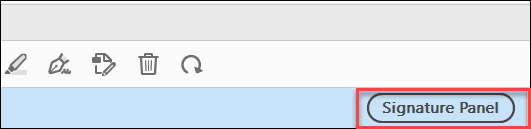
 7. Click the Signature Panel button.
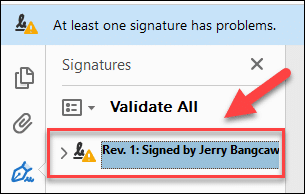
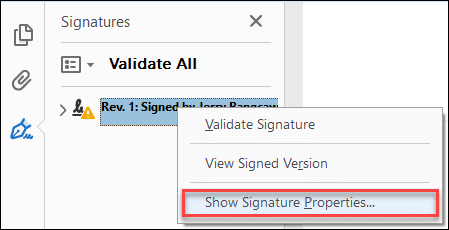
8. Left-click the particular digital signature that you want to validate.
9. Right click the digital signature and click Show Signature Properties
 10. Click Signature Properties
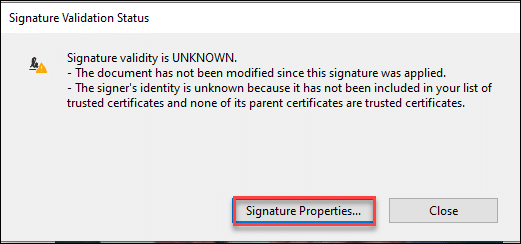
11. Adobe will display the two messages:
a ) Signature validity is UNKNOWN.
b) The signer’s identity is unknown because it has not been included in your list of trusted certificates and none of its parent certificates are trusted certificates.
Click Show Signer’s Certificate to validate the signature and the signer’s identity.
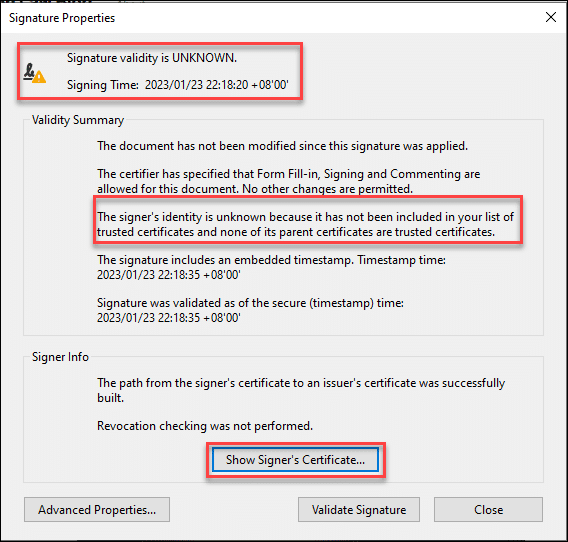
SSL.com’s Document Signing Certificates are trusted worldwide to digitally sign and certify Adobe PDF documents with secure digital signatures.
12 . Click the name of the test certificate to highlight it. Select the Trust tab and then click the Add to Trusted Certificates… button.
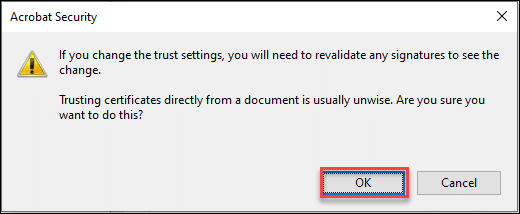
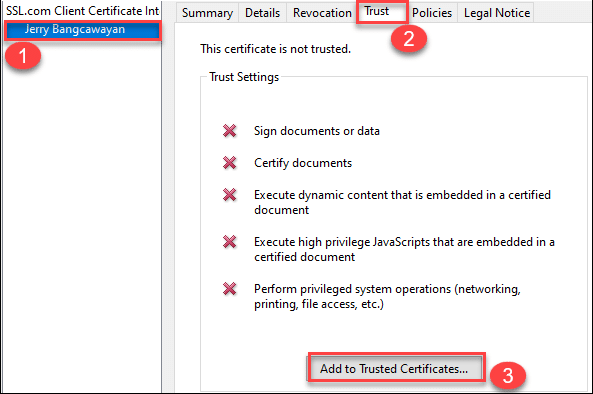 13 . A dialog box will appear asking you to confirm if you want to trust the certificate. Click the OK button.
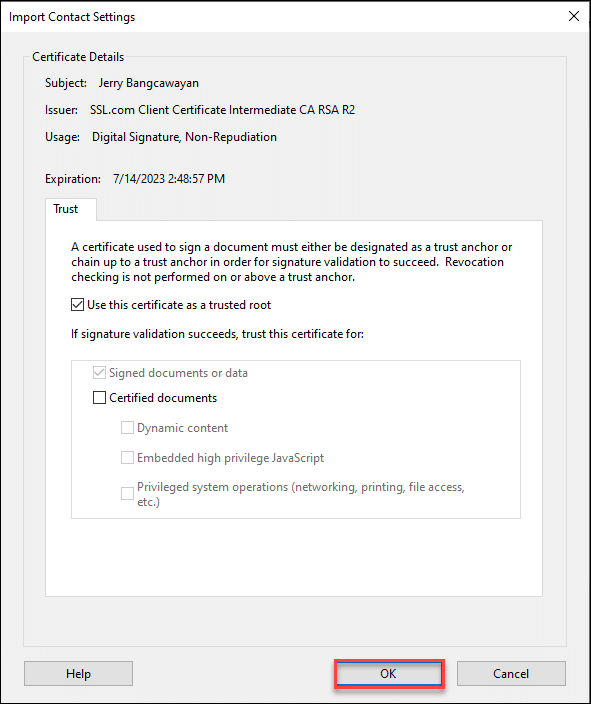
14. Another dialog box will appear providing you options on which cases you want the test certificate to be trusted:
a) Use this certificate as a trusted root : There should be a tick in the check box for this option. This will enable your test certificate to be directly trusted by Adobe.
b) Signed documents or data : Adobe sets a default check mark for this option.
c) Certified documents : This feature is optional and allows the test certificate to be trusted for Dynamic content, Embedded high privilege JavaScript, and Privileged system operations (networking, printing, file access, etc.). You can leave this feature un-checked if you do not need any or all of these three functions.
Once you have made your choice, click the OK button.
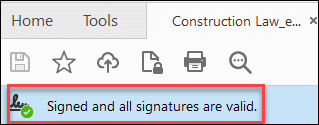
15. The test certificate is now trusted! Close the PDF file, re-open it, and you should then be able to see the digital signature shown by Adobe Acrobat as valid. You will also see that the exclamation point symbol is now replaced by a check mark in a green circle, indicating that the signature is indeed valid.
 16. Click the Signature Panel again to view the details of the trusted signature.
 17. Highlight the signature, right-click it, and select the Show Signature Properties option.
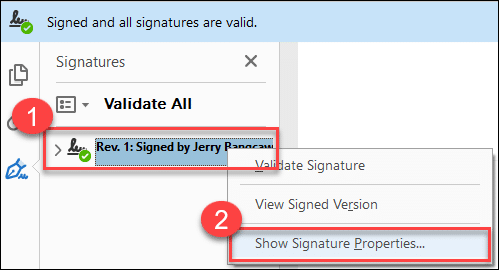
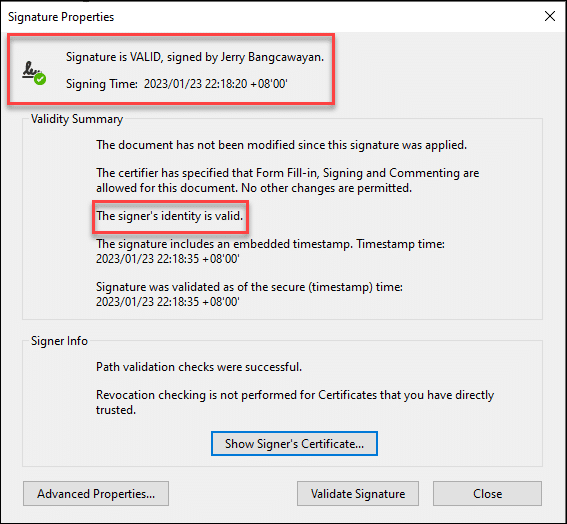
18. You will then see that Adobe now shows the signature and the signer’s identity as both valid. Click the Show Signer’s Certificate… button again to see further details about the test certificate that is now trusted.
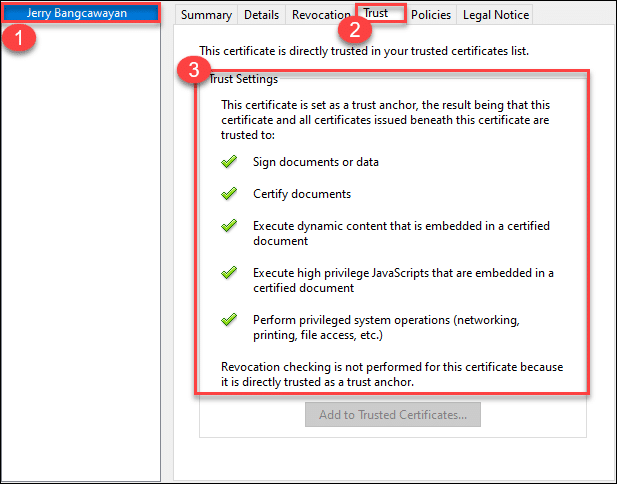
 19. Highlight the name of the test certificate. Click the Trust tab. Adobe places a green check mark for the particular task that the certificate is enabled to do. In this case, the test certificate has been enabled to be trusted on all available options provided by Adobe Acrobat.
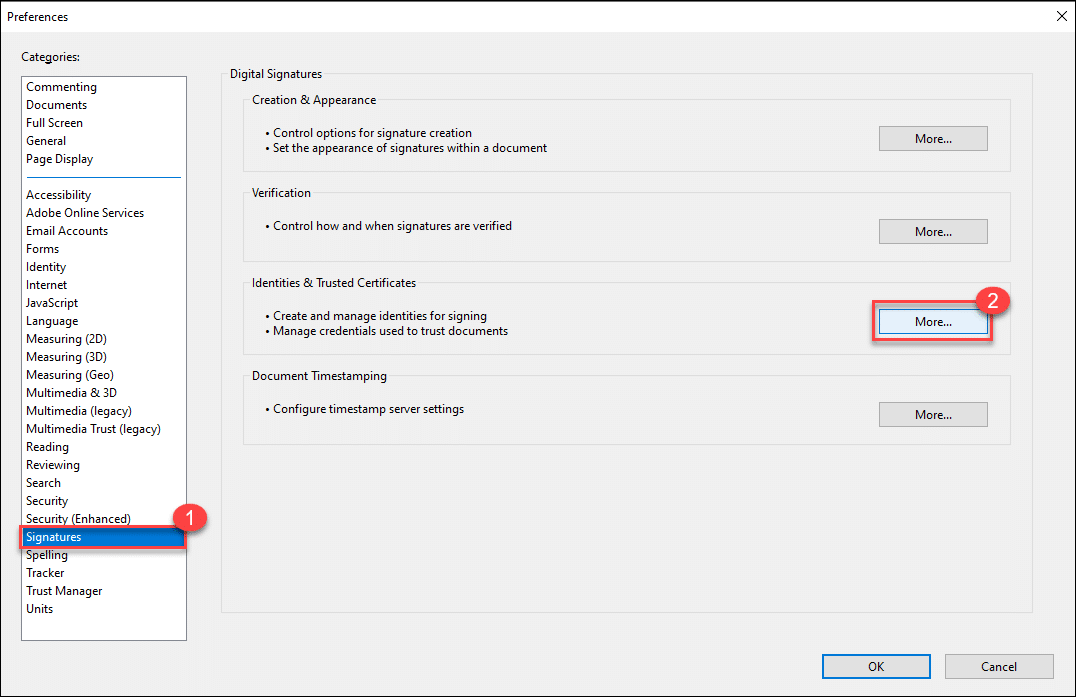
 20. If you want to see the trust list on which your test certificate is added by Adobe, click the Edit tab on the top menu and then Preferences… or you can also type Ctrl+K to take you directly to the Preferences window. Once there, select the Signatures category and click the More… button for Identities & Trusted Certificates.
 21. Click Trusted Certificates and scroll down the list to see the name of your test certificate. Once selected, you will see that Adobe recognizes its validity period and its use for digital signing.
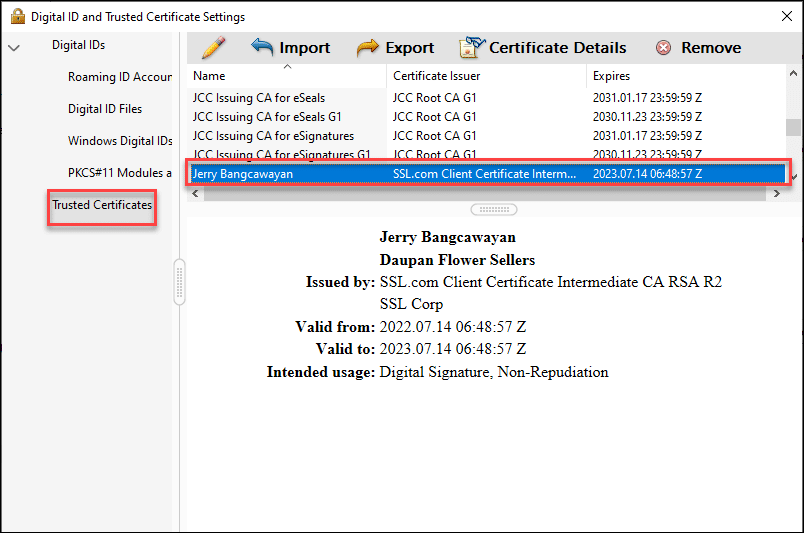
Note: The next time you use your validated test certificate to sign another PDF document, Adobe Acrobat will immediately show the certificate as valid and trusted once you open the signed file.
Need Custom Solutions?
With our expert knowledge and five-star support staff, we’re ready and willing to work with you on custom solutions or enterprise-level high-volume signing discounts. Fill out the form below and we’ll be in touch.