What Is an NFT (Non-Fungible Token)?
A non-fungible token (NFT) is a digital token that has a unique, one-of-one identifier differentiating it from any other blockchain token.
NFTs are an evolution in blockchain-based assets, moving beyond cryptocurrencies, stablecoins, governance tokens, and utility tokens to provide users a new kind of digital asset with innovative models of ownership and distribution.
In this article, we cover what NFTs are, the rapid growth of the NFT collectibles economy, the features that make NFTs desirable, and the different types of NFTs in industries ranging from art to gaming. Then, we’ll explore how you can build your own NFT collection with cutting-edge Web3 tools such as Chainlink Verifiable Random Function (VRF).

This renewed interest in NFTs led to a Cambrian explosion of unique applications that leverage the property of non-fungibility in innovative ways, often with the goal of increasing efficiency in the transfer of asset ownership and reducing the need for intermediaries who siphon value away from creators and marketplaces. However, NFTs are still largely in their infancy, meaning there is a vast amount of opportunity for growth from innovative developers, creative artists, and traditional institutions wanting to bring distinct assets on-chain.
The Value in NFT Technology
A hallmark feature of any NFT is that it is a unique, 1-of-1 identifier that can help prove ownership, authenticity, and provenance. These distinctive features have opened a host of possibilities: Artists can monetize their digital masterpieces, games can sell provably rare in-game items, and creators can build digital collectible ecosystems and communities.
NFTs serve as a foundational building block for developers—there is no “form” that an NFT must take. It can be used to wrap music, immortalize art, tokenize real-world assets, and much more. One NFT use case that took the Web3 industry by storm is the emergence of collectible profile picture (PFP) collections like Bored Ape Yacht Club (BAYC) and Azuki. These collections present a harmonious design narrative, with each NFT boasting unique trait combinations. The individual value of any PFP NFT often hinges on trait rarity, leading to a general pricing strategy based on the “floor price”—the price of the least expensive NFT in the collection.
However, one size doesn’t fit all. While the floor price model might suit PFP collections, it isn’t applicable to a standalone piece of digital art minted as an NFT, for example. This can be a challenge for NFT finance (NFTFi) protocols, which seek to unlock liquidity for NFT owners by providing financial rails such as NFT lending protocols.
Exploring the Different Types of NFTs
NFTs offer a flexible framework for tracking ownership of a wide array of digital and physical assets using a blockchain network, as well as adding utility (such as NFTFi) to these assets in any number of interesting ways. The variety of use cases for NFTs is expanding, but below are a few common applications that have emerged.
Digital Art NFTs
One of the most recognized NFT use cases is tokenized ownership of digital artwork. By tokenizing their work, artists are able to monetize their craft and then tap into a global market of potential customers that only need an Internet connection to purchase it. Compared to traditional art marketplaces, which are often opaque, value-extracting, limited in discoverability, and require significant listing fees, NFTs can be listed on global, permissionless online marketplaces and can even provide creators revenue from all secondary sales.
An example of NFT art that made headlines is the famous digital artist Beeple. His piece “Everydays: The First 5000 Days,” a collage of 5,000 images that took 13 years to create, was tokenized as an NFT on Ethereum and sold for over $69M. Using the popular ERC721 token standard, Beeple was able to monetize his digital artwork and establish cryptographic proof that the specific NFT was the official copy. Beeple’s artwork is only one of thousands of different collections of digital art released and sold worldwide as NFTs.
Gaming NFTs
NFTs are a foundational component of blockchain-based video games because they allow unique in-game items to be tokenized, tracked, and transferred in a non-custodial manner. With traditional online video games, centralized publishers have complete control over the distribution, ownership, and attributes of in-game items that often determine the value of certain characters and game outcomes. If the publisher shuts down, users lose access to all of the game items they potentially spent hours, days, weeks, or even longer acquiring.
NFTs not only ensure users have complete control over their game items, but they enable entirely new gaming possibilities. This includes the creation of an interoperable metaverse—where the items from one game can be used and traded in another, and even marketplaces for lending and renting various game NFTs.
The implementation of gaming NFTs varies across games, from tokenizing cosmetic skins in MOBA and FPS games and characters in MMORPGs to creating general community membership NFTs that provide holders with early access to new game features, governance power to help shape a game’s direction, and more.
NFT Collectibles
Similar to collecting physical trading cards or mail stamps, NFTs empower a new type of digital collectible. Collectors can buy digital objects they deem valuable or signal their support for a specific company, brand, game, or artist. Unlike physical collectibles that can be slow to transport and expensive to maintain, NFTs have no such restraints as they are entirely digital, transferrable in seconds, and never degrade in quality.
Some of the most recognized NFT collectibles are CryptoPunks, a collection of 10,000 unique 8bit-style characters algorithmically generated so no two characters are exactly alike. CryptoPunks were some of the first NFTs ever created and were given away for free. They continue to attract users who want to own an original piece of NFT history.
Collectible NFTs are increasingly being used as profile pictures on social media platforms like Twitter and Discord. Doing so provides a powerful signaling mechanism, where like-minded individuals can display their interest in an NFT collection and join a community of like-minded individuals.
Music Album NFTs
Blockchains have given music artists the ability to tokenize their work through music NFTs as a way to increase their revenue and foster fanbase engagement. With the Covid-19 pandemic contributing to an 85% reduction in music industry revenue, supplemental income from NFTs has helped artists offset these losses while at the same time providing fans a way to earn special perks like limited-edition memorabilia and even direct access to the artist’s time.
A wide range of music artists such as 3LAU, Kings of Leon, Shepard Fairey, and Eminem have tokenized their work, generating millions of dollars in the process. As a result, NFTs have served as a new, more engaging, and creative medium for creating fan reward programs and galvanizing community support for artists.
Real Estate NFTs
NFTs can also represent ownership of real-world assets like real estate to introduce additional liquidity into traditionally fragmented markets. The tokenization of real estate significantly increases the efficiency of transferring ownership and provides a single source of truth around the authenticity and provenance of a specific property. The concept of tokenizing real-world assets can be expanded to include many asset types such as physical paintings, government documents, certifications, and diplomas.
While still in the early stages, real-world assets tokenized as NFTs enable a number of new possibilities, from revenue-generating real-estate tokens backed by rental income to issuing digital credentials without the need for a physical document counterpart. They can also digitize existing records like educational diplomas and intellectual property contracts, leading to more transparency of credentials and opening up new forms of automation.
Start Building Your Own NFT Project
Every use case stated above is still in its nascent stages. From pioneering successful monetization models to the establishment of universal technical standards, NFTs have a long way to go before they’re used and adopted at scale. Building a breakthrough NFT project, collection, or application is difficult—but that difficulty also means there are unparalleled opportunities for a savvy entrepreneur willing to dive deep into the tech.
That’s where Chainlink steps in, with a wealth of tools and educational materials on offer to streamline the Web3 development journey and unlock innovative use cases. The very first step for any NFT developer is to understand how to create and mint an NFT. The next natural step is to build a dynamic NFT (dNFT), or an NFT that evolves based on preconditioned triggers,
This is as far as many NFT collections have gone so far, but to build something that truly stands out, developers need better tools.
As the industry-leading Web3 services platform, Chainlink provides developers with simple but powerful services that extend the features of any NFT or smart contract. For example:
- Verifiable Randomness:Chainlink VRF has helped power a generation of NFT collections with provably fair NFT minting processes. NFT users want to know that their NFTs’ traits were distributed in a fair manner—and in a truly Web3 fashion, VRF provides cryptographic proof of randomness.
- API Connection: Whether it’s upgrading dNFTs from an off-chain game server or changing a dNFT based on the weather outside, Chainlink Functions seamlessly connects all the world’s data to NFT smart contracts. The possibilities are endless.
- Cross-Chain Connectivity: Today’s blockchains are isolated from each other, making it difficult for users to access an NFT on one blockchain when they’ve already onboarded to another blockchain. Chainlink’s Cross-Chain Interoperability Protocol (CCIP) unlocks true cross-chain NFTs, expanding the potential user base for any NFT application.
- Smart Contract Automation: As NFT use cases get more advanced, developers will run into an important challenge—reliably automating their smart contract functions. Chainlink Automation is the leading solution, unlocking set-and-forget implementations that save countless development hours.
Developers who are serious about building a breakthrough NFT application or project need Chainlink services to stand out from the crowd. In the current paradigm of isolated, one-off, static NFT implementations, innovation is just one Chainlink service away.
BabyFit NFT Mint by DEFIT
The BabyFits are coming to life this month with the Genesis collection! Bringing a whole new level of fun and gamification to the DEFIT world.
This incredible collection will unlock our 3rd game mode: Web3 Player.
A perfect blend of art + utility with a powerful concept (read more here). More than an NFT collection, it is a lifestyle.
Enter and discover the BabyFit World: https://babyfit.defit.com/
Website available in 6 languages.
Here is everything you need to know to prepare yourself for the mint.
General information
The total supply of the BabyFit Genesis collection is 1,500 and will be live on the Ethereum chain. Mint price will be around 0.2ETH but will not exceed $350USD.
Genesis BabyFits will come with lot of extra perks and benefits in addition to the core attributes. Valuing our early and loyal supporters is and will always remain a priority for us.
Key dates and mint process
Reminder: Our mint will be a whitelist only mint. If you haven’t got one yet hurry to join our discord here and find out how to get one.
WEDNESDAY APRIL 19th : PRELAUNCH PARTY IN PARIS
DEFIT Team is organising a prelaunch party in Paris. This is an “invite only” event. If you’re in Paris and would like to join us please reach out to our team via discord here.
FRIDAY APRIL 21st — 23rd : 200 FREEMINT — 48 hours
Following our recent snapshot taken in-app on March 28th, if you were holding over 19 886 DEFIT tokens, you made it within the TOP 200 and are eligible for a free mint (note: you will still need to pay for the gas fees so make sure to have some ETH available in your wallet).
Free mint window will open on Friday 21st — 12PMUTC and will be available for 48 hours until Sunday 23rd — 12PM UTC.
Free BabyFit NFTs are meant to reward our community by giving them a pass to the web3 player mode when launched.
All free mint NFTs will have a 3 months lock period post reveal. It means you won’t be able to sell or transfer them before the end of the lock period.
Important note: It is your responsibility to claim your free mint during this period. Once time window is closed, no free mint will be possible and unclaimed tokens will be added to the Private sale pool.
TUESDAY APRIL 25th — 28th : 1,000 PRIVATE SALE — 72hours
Our presale of 1,000 Genesis BabyFit is a whitelist only mint.
All DEFIT Club Members will be automatically granted a guaranteed mint. If you do not have a whitelist spot yet we invite you to join our discord and follow our twitter to find out how to get one. Alternatively you can register on waitlist via our website: https://babyfit.defit.com/
Private presale mint window will open on Tuesday 25th — 12PM UTC and will be available for 72 hours until Friday 28th — 12PM UTC.
Here are the rules for the Private Sale:
- Eligibility: whitelisted wallets only
- Supply: 1000 NFT
- Currency: ETH, USDC, USDT
- Mint Price: 0.18 ETH or $333 USDC/USDT
- Maximum mint per wallet: 3
WEDNESDAY MAY 17th : REVEAL PARTY LIVE ON YOUTUBE
DEFIT Team will organise a live Youtube Reveal Party to celebrate this key milestone and share our excitement discovering our BabyFits stats and attributes.
The remaining 300 Genesis NFTs will be kept in treasury for future challenges and marketing activities.
Collection details
Our private sale include only genesis BabyFits at a fixed price cheaper than common BabyFits (non-genesis) that will later be available within our in-app and web marketplace. But that’s not all!
We have decided to throw in the mix of 1,200 no less than 239 BabyFits of higher Talent! Giving you 20% chance to mint one of higher tier. Here below is the split of Talent (rarity):
1 out of 5 chances to get at least an uncommon BabyFit is an opportunity to not miss. Talent will define the base attribute stats affecting your in game rewards and energy depletion.
In addition our BabyFit all have a sport specialty as follow:
What comes next?
The first playable features of web3 player mode will become available within Q2 2023. DEFIT plan to launch its own DEX and mobile/web NFT marketplace with all in-game assets available for trading in early Q3.
At this stage you will be able to choose the talent of the BabyFit you buy: Common, Uncommon, Rare, Epic, Legendary with a starting price of $400 for the common ones.
Users will get the opportunity to buy BabyFit NFT with various currencies, including our own DEFIT native token.
So here we are! Few days left before the BabyFits comes to our world! If you are not already on our Discord, feel free to join the conversations there with the rest of the community and ask any questions you may have (link below). We look forward to seeing you there !
Follow us on all our social media platforms to get the latest updates.
Global Fit Club is bringing NFT membership model to fitness industry

From Shopify’s ‘token gating’ to Starbucks’s loyalty program and ‘Journey Stamps’, NFT membership models are really catching on among brands.
Now, Global Fit Club, a blockchain-based fitness platform, will soon begin offering NFT memberships to provide users with access to a comprehensive suite of fitness services. Mixing the billion-dollar fitness industry can bring a lot of attention towards NFTs.
Global Fit Club plans to launch in Quarter 1 of 2023, and apparently, the company is partnering with well-known fitness centres like Anytime Fitness and F45 Training.
Members with an NFT membership will have access to a variety of exclusive benefits, and Global Fit Club will also incentivize users to work out through its move-earn platform, which pays NFT holders cryptocurrency when movement is recorded.
«This isn’t just a gym membership. NFT holders will get discounts on fitness related services such as supplements, personal training and equipment, as Global Fit Club has a number of partners lined up to provide this,» said Deni Zulic, CEO and founder of Global Fit Club.
An NFT-based gym membership can solve many problems, mainly price fluctuations. Also, If a member chooses to cancel their membership, they may be able to resell their NFT and even profit depending on the asset’s value over time.
«With NFTs, gym members can have full ownership of their memberships. They can lock in a certain rate and then sell their membership if they choose,» Zulic said.
The standard NFT membership at Global Fit Club is cost-effective and gives members lifetime access to partnering gyms in the United States. The team also believes that the company’s move-to-earn platform will likely cover the cost of a member’s NFT within seven months.
Binance, Huobi Blocks FTT Deposit After $400M Worth of Tokens Illicitly Released
Following the unscheduled release of around $400 million worth of FTX’s native tokens on Sunday, cryptocurrency exchanges Binance and Huobi halted deposits of FTT.
The release of vast quantities of FTT tokens occurs on a regular basis according to a schedule for unlocking the tokens. But on Sunday, the tokens were distributed early without prior notice or communication from FTX or connected parties.

The Drama continues: late on friday night, hundreds of millions of dollars worth of currencies were reportedly stolen from many wallets supposedly owned by FTX. A large portion of the money was moved from Tether (USDT) into the stablecoin DAI and from staked Ethereum (stETH) into Ethereum (ETH).
The same day, FTX filed for Chapter 11 bankruptcy, and the acts appeared too well-planned, premature, and sophisticated.
Mercedes F1 Team Suspends FTX Deal Amid Company’s Collapse
After launching in 2019 and rising to a $32 billion valuation in only three years, the crypto derivatives exchange FTX is now declaring Chapter 11 bankruptcy.

FTX invested heavily in sports sponsorships, and now that the company is collapsing due to a liquidity crisis, we are beginning to witness the effects of those partnerships. Mercedes-AMG Petronas, a well-known Formula One team, said today that it is discontinuing its sponsorship agreement with FTX.
For this weekend’s So Paulo Grand Prix in Brazil, the team will take the FTX branding off their vehicle.
FTX and FTX US inked agreements with Major League Baseball and the NBA’s Miami Heat (stadium naming rights) in the second half of 2021 alone. The most well-known was a 19-year, $135 million pact with the Miami Heat. Now it’s also cancelling the partnership, and the arena will get a new name.
FIT’s First Student NFT Contest
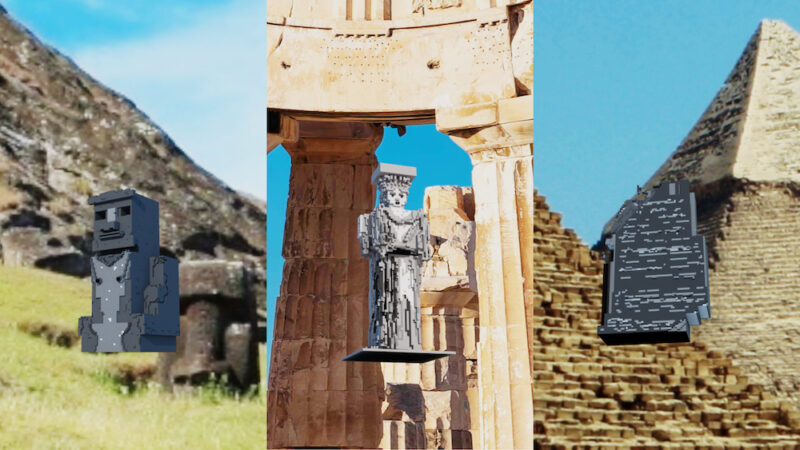
Fabriq Labs, a startup that empowers creatives to use Web3 technologies to improve society, sponsored an NFT contest through FIT’s Entrepreneurship Department this spring. Students from all majors were invited to submit digital artworks that could be made into NFTs; on May 5, ten student finalists presented their proposed collections in the Katie Murphy Amphitheatre. Four winners received a total of $5,000 in prizes.
First prize went to Harry Xizhuo Lin, Advertising and Digital Design ’23, for his collection, “Stolen History of Art.” To raise awareness of stolen artworks in museums and the movement to repatriate these pieces, Lin created digital versions of three such artworks housed in the British Museum: Hoa Hakananai’a, an Easter Island statue created by the Rapa Nui people; a Caryatid from the Acropolis; and the Rosetta Stone, discovered in Egypt.
Lin embedded these pixelated artworks into photographs of the places from which the original artworks were stolen, and he plans on exhibiting these in a digital gallery, complete with descriptions of history of each piece. This project was an outgrowth of his senior thesis.
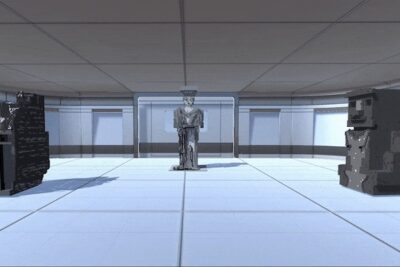
Visitors to his virtual museum “can scan the artifacts to keep the authentic history,” Lin says. “The meaning of the artwork changes over time, depending on who’s holding it, who’s taking it from whom, and where it’s been sent. I want Gen Z to learn about this, because more people are forgetting about history.”
Lin plans on using the $2,500 prize to mint the NFTs and build out the digital gallery.
William Reinisch, associate chair of Entrepreneurship, and Renee Leibler, adjunct assistant professor of Entrepreneurship, who teach courses about Web3, organized the contest and advised the students. The judges were Sam Whitaker, CEO of Hold On Development Labs and Fabriq Labs; Nico Fara, founder and leader of the Fashion DAO; Brittany O’Hagan, vice president of partnerships at Dapper Labs and Dapper Sports Studio; and CryptoNovo, an NFT influencer.